Two Straws, One Aquifer: The Cumulative Water Question No One Has Answered
A 3,750-megawatt power plant and a hyperscale data center would sit side by side at 20-Mile Bend. The county is studying the data center's water demand in isolation. The real question is what their combined draw does to the shallow wells next door.
The Wrong Question Has a Comforting Answer
Ask the developer "how much water will the data center use?" and you get a reassuring number: about 5,000 gallons a day, they say — roughly one busy restaurant, drawn from a closed-loop system that recycles the same water.
It is the wrong question. And the wrong question always has a comforting answer.
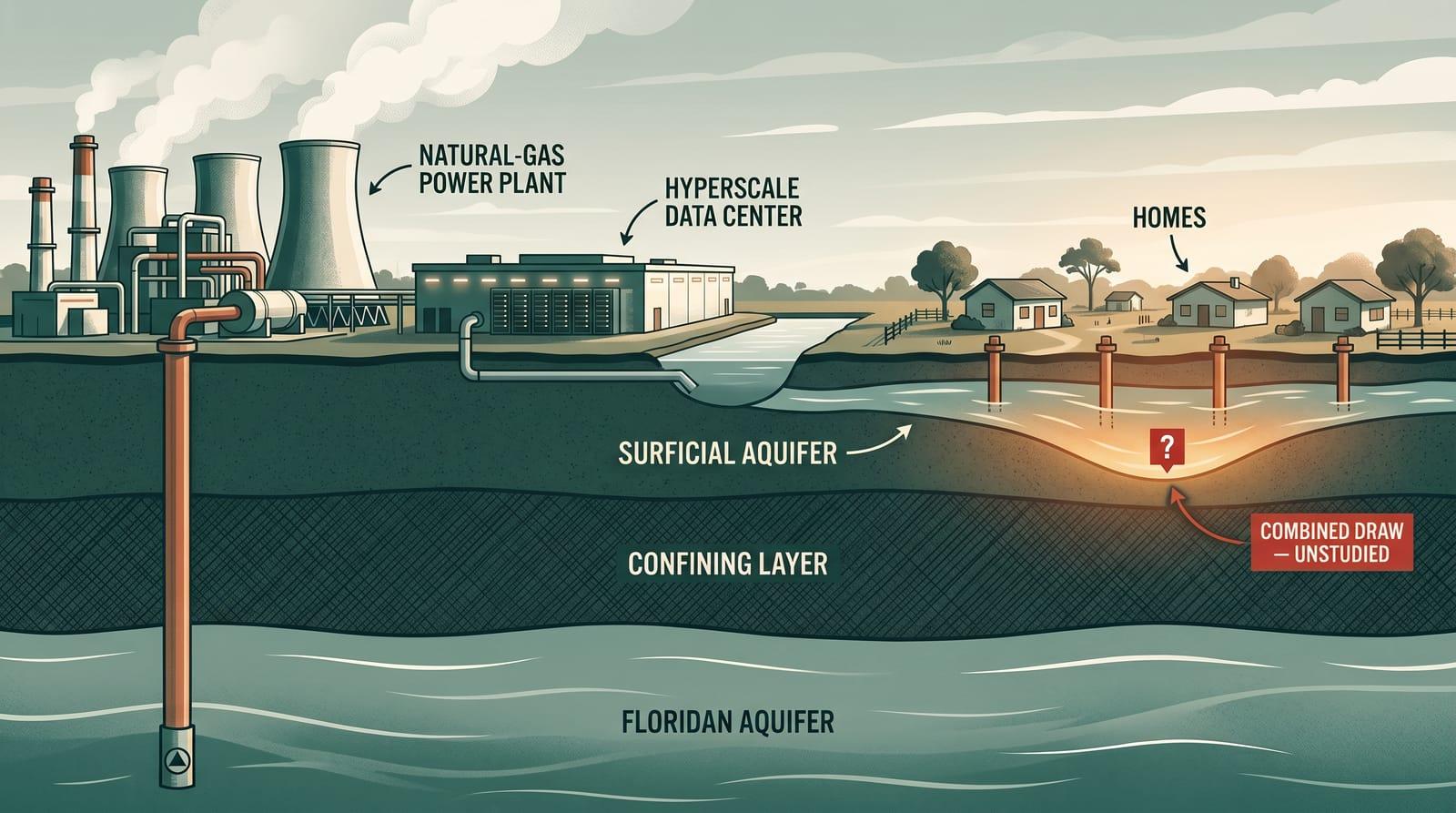
Project Tango would not be built in an empty field. Its roughly 200-acre site at 20-Mile Bend sits immediately east of Florida Power & Light's West County Energy Center — a 3,750-megawatt natural gas plant large enough to power 750,000 homes, with its own deep wells, its own reclaimed-water line, and its own permitted claim on this corner of the county's water budget. Two of the most water-hungry kinds of industry in existence, stacked side by side, on the rural western edge of Palm Beach County, a few miles from thousands of homes that pump their drinking water straight out of the ground.
The county is reviewing the data center's water demand as if the power plant next door did not exist. That is the gap. The right question is not "how much water will you use?" It is: what happens to the wells next door when you and the power plant draw at the same time?
What a Cone of Depression Actually Is
The hydrology here is not exotic. Pump water out of the ground faster than it refills and the water table around the well drops into the shape of an inverted cone — a cone of depression. The drawdown is steepest right at the well and tapers with distance. The bigger the pump, the wider and deeper the cone.
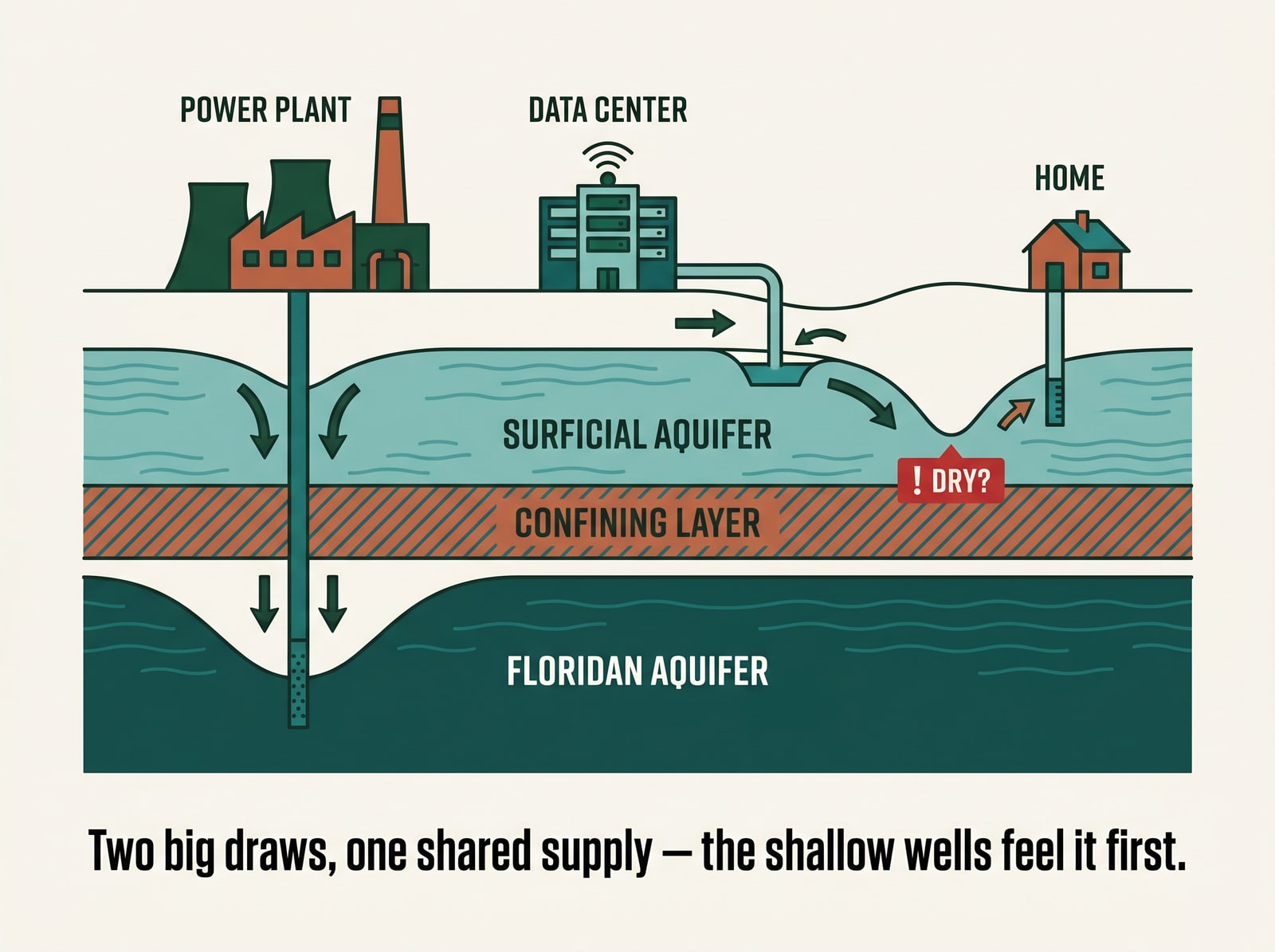
Here is the part that matters when big users cluster: when two large withdrawals pull on the same body of water, their cones of depression overlap and the drawdowns add together. Hydrologists call it well interference — a point caught between two pumping centers feels the sum of both, not just the deeper one. How strongly two draws actually interfere depends on whether they tap the same layer and how those layers connect underground — which is exactly the kind of thing a cumulative study exists to measure, and exactly what no one here has measured.
That is why studying one straw at a time is misleading by design. You cannot understand the load on a shared water system by collecting reassurances about each user in isolation — and at 20-Mile Bend, isolation is exactly how the review is being run.
Two Industrial Giants, One Corner of the County
Look honestly at what is already drawing here, and what is being added:
The power plant (FPL West County Energy Center). It originally pulled cooling water from the Floridan aquifer through wells 1,400 to 1,700 feet deep, and injects its waste brine into wells reaching 3,200 feet. Since 2011 it has run primarily on reclaimed water piped from regional wastewater plants. It still holds its groundwater permits and its place in line for the region's finite reclaimed supply. This is, by any measure, one of the largest single water users in western Palm Beach County.
The data center (Project Tango). The developer says it will use a closed-loop system needing only ~5,000 gallons a day of potable water from county utilities, with reclaimed water as a backup "if they need it" — and points out, tellingly, that it sits next to FPL's reclaimed-water infrastructure. But the county's own staff report says the cooling method is "not yet determined," and the filing reserves 314.3 ERCs — roughly 1.76 million gallons per month, about 56,600 gallons a day. That is eleven times the public number. (We laid that gap out in The Water Numbers Don't Add Up.)
Now notice what these two have in common. Both are drawing on the same finite regional reclaimed-water supply. Reclaimed water is not infinite — every gallon the data center takes is a gallon the region cannot use elsewhere. And when reclaimed runs short, in a dry-season drought, the fallback for everyone is the same thing under everyone's feet: groundwater. Two of the biggest possible draws in the county, competing for one finite supply, backstopped by one aquifer system. That is the definition of cumulative impact — and no one has modeled it.
The Wells That Pay First
Three to four miles away, the families of The Acreage and Loxahatchee do not turn a tap connected to a treatment plant. They pump their own water from private wells in the shallow surficial aquifer — many only 40 to 100 feet deep, with the water table sometimes 10 to 20 feet below the grass. Thousands of households, no utility buffer, no backup line. Just a pump, a pressure tank, and a column of groundwater that has to stay high enough to reach.
Shallow wells are the first to fail. When a water table drops, depth decides who keeps water: the deep municipal and industrial wells reach hundreds or thousands of feet down and barely notice, but the 60-foot residential well is the one that sputters, sucks air, and runs dry. And the failure is not symmetric:
- The developer gets a 30-year asset. The neighbor gets a dead pump, a $10,000–$30,000 bill to drill deeper, and weeks hauling water in the meantime.
- Passive monitoring without enforceable triggers is a receipt for damage already done. A gauge that records the water table falling — with no automatic shut-off when it crosses a line — documents the harm instead of preventing it. The only monitoring worth anything here is the kind with teeth (see below).
- You cannot un-draw an aquifer on a hearing schedule. Once the cone deepens, the water doesn't come back because a commissioner regrets the vote.
That is the liability the current review quietly transfers from the company to the family next door. The burden of proof is pointed the wrong way.
The Question We're Asking the County
We are not asking the county to take our word for the hydrology. We are asking it to make the applicant prove the cumulative case before the vote, not after the wells go dry. The right question, on the record, is one sentence:
What is the combined effect of the FPL West County Energy Center and Project Tango — at full build-out, in a drought-year dry season — on the water table beneath the residential wells of The Acreage and Loxahatchee?
There is no honest answer to that question today, because the study that would answer it has never been done. But the legal footing to demand it is already in place. Florida's SB 484 — signed into law this year and taking effect July 1, two weeks before the hearing — requires large-load facilities like this one to obtain their own distinct consumptive-use permit. And under Florida law a consumptive-use permit can only be granted if the use will not interfere with any presently existing legal use of water and is not harmful to the water resources of the area. (What SB 484 does.) Thousands of existing residential wells are exactly that kind of presently existing legal use. No one can certify that a combined draw won't interfere with them without first modeling the combined draw — and that is precisely the study we are asking the South Florida Water Management District to run before the vote. The standard is already on the books. The county simply hasn't applied it.
Before July 15
Ask the County Commission to make these conditions of any approval:
- A cumulative drawdown model from the South Florida Water Management District — the combined effect of both the power plant and the data center on the surficial aquifer, modeled for a drought-year dry season, before the vote.
- A binding cooling-technology commitment. No "not yet determined." If it's a 5,000-gallon closed loop, write that into the approval as an enforceable cap and surrender the 314 ERCs that say otherwise.
- A residential-well protection guarantee. If the combined draw lowers a neighbor's water table below the reach of their well, the developer pays — to deepen it, replace it, or connect the home to a main. In writing, funded up front.
- Independent monitoring with teeth — public, real-time well-level data and automatic curtailment if drawdown crosses a set threshold.
If the developer's water claims are as modest as they say, none of this costs them anything. The only reason to resist a cumulative study is fear of what it would show.
How to help: Sign the petition, contact your commissioner, and attend the July 15, 2026 County Commission hearing.
Sources
- Project Tango / Central Park Commerce Center — site location at 20-Mile Bend, east of FPL's West County Energy Center
- Power Magazine — West County Energy Center: Floridan aquifer wells (1,400–1,700 ft), reclaimed-water transition, 3,200-ft injection wells
- FPL — West County Energy Center overview
- CBS12 — What's actually proposed: developer water claims, closed-loop cooling, reclaimed-water access
- U.S. Geological Survey — Aquifers and Groundwater (cone of depression, drawdown)
- USGS — Cone of depression: how pumping lowers the water table
- South Florida Water Management District — Consumptive use permitting
- SB 484 — Florida Senate Bill Tracker
Share this article